
A filling is a procedure used to replace the part of the tooth crown that has been damaged by decay, by a fracture, or by chemical (erosion) or mechanical (attrition) factors. A filling stops the decay process and restores the tooth’s structural integrity, function and appearance.
Filling Materials
Several materials are used to fill teeth:
 Composites – These materials are widely used for fillings. They are also known as “white fillings”. Because they are easy to shape and their colour is almost identical to the natural colour of the tooth, they ensure an optimal aesthetic result. They have good mechanical strength and do not require a cavity with a retentive shape, so less tooth tissue has to be removed with the drill. They must be placed in a completely dry cavity.
- Amalgams – These materials have been used to fill teeth for a long time. They have very good mechanical strength and are highly resistant to
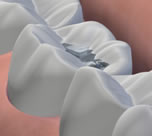 the pressure of chewing forces, which is why they are widely used to fill molars, where these forces are high. Their drawback is that these fillings are not aesthetic; moreover, because amalgam does not bond to the tooth surface, the cavity has to be prepared in a geometric shape that keeps the filling stable. They tolerate moisture better than composites, so they can be used when, for various reasons, a dry field cannot be guaranteed.
- Glass ionomers – These are used mainly to fill the necks of teeth or in children’s baby teeth.
The filling material is chosen according to where the cavity is, aesthetic needs, how strong the chewing forces are, how long the filling needs to last, and your own preference.
The Filling Procedure
Filling a tooth involves two main stages:
- Preparing the cavity for the filling. In this stage, using various types of burs, the decayed tissue is cleaned out (that is, the decayed parts of the tooth are removed), overhanging walls (enamel not supported by dentine) are removed, the edges of the cavity are rounded and, finally, the cavity is disinfected.
- Filling the cavity. At this stage, if the tooth is vital (has a live nerve), an insulating layer is placed to protect the nerve from chemical, thermal and physical stimuli. If the tooth is non-vital, an insulating layer is still placed, but in this case its purpose is to seal the entrance to the root canal hermetically after the canal has been filled. Once the insulating layer is in place, the filling material is chosen according to the criteria mentioned above and the tooth is filled. When the filling is complete, any excess is removed with a bur, and the filling is smoothed and polished with discs and rubber polishers. With composite fillings, which are fully hardened by the curing lamp, you can eat as soon as the session is over, while with amalgam fillings you should not eat for about 2 hours, until the filling has fully hardened. Amalgam fillings also need a second session after 24 hours, for the final polishing of the filling with round burs.
Having a tooth filled is painless, as the procedure is carried out under local anaesthetic.