
What Are Dental Implants?
Dental implants are designed to be placed inside the bone of the jaws.
They are used when some or all of the teeth are missing, to replace them without touching the neighbouring teeth. They are contraindicated in cases of weakened immunity, treatment with corticosteroids, blood clotting problems, severe endocrine diseases, rheumatoid disorders, bone diseases, liver cirrhosis, etc.
Locally, they are contraindicated in osteomyelitis, radiotherapy, recurrent diseases of the oral mucosa, poor oral hygiene, etc.
They are made from a metal that is biocompatible with bone (titanium).
They come in different lengths and diameters, depending on the anatomy of the site where they will be placed.
The surface is threaded and may or may not be coated with hydroxyapatite (HA).
In line with EC directives on medical devices, the implants are sterilised by gamma radiation and packaged in double glass vials.
After the implants are placed, it is essential for the patient to maintain very good oral hygiene.
The surgical procedure is carried out in a single session, while the prosthetic stage (fitting the teeth) follows after at least three months.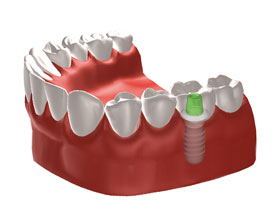
What Are the Advantages of Implants?
-The great advantage of implants is that they protect the jawbone from loss (shrinkage).
-They replace one or more teeth without touching the adjacent ones.
-They can support a fixed bridge, removing the need for a removable denture.
-They provide support for a removable denture, making it more comfortable and stable.
-The function of an implant is to replace the root of a lost tooth.
-The ideal candidate for a dental implant is someone with good oral hygiene.
-Are Implants Safe?
In clinical assessments worldwide, dental implants have proven excellent in terms of aesthetics and predictability.
The guarantee on porcelain work is 5 years.
If anything is unclear or you would like more detail, do not hesitate to ask for further explanation.
You can be confident that you have made the best choice for the comfort of your mouth.
Information About Dental Implants
Over the last 30 years, dental implants have changed dentistry from its foundations. They are no longer considered experimental, as the situations in which they cannot be used are rare.
What Is a Dental Implant?
Almost all implants made today are of titanium or titanium alloys, materials that have proven over the years to be very well tolerated by bone. The term “osseointegrated implants” is widely used to describe dental implants that achieve a close bond with the bone, so that they can hold the replacement tooth on top.
A dental implant is essentially a replacement for a natural root and is usually cone- or cylinder-shaped. Each implant is placed in a carefully pre-drilled site, in a precisely planned position. The main aim when placing any implant is to achieve immediate, close contact with the surrounding bone. This creates primary stability, which is reinforced over time as further bone grows into the microscopic roughness of the implant surface.
To hold the tooth that will be fitted, dental implants normally have an internal threaded channel that allows various components to be attached. These components provide the foundation for the crowns, bridges and dentures that will be placed on top.
How Many Teeth Can an Implant Support?
All the usual forms of tooth replacement, such as dentures or bridges, can be replaced with dental implants.
If you are missing a single tooth, one implant is all you need to replace it. Larger gaps left by two, three or more missing teeth do not necessarily have to be restored with one implant per missing tooth; however, the exact number of implants will depend on the quality and volume of the bone at each site where they will be placed.
Depending on the case, it is also possible to join natural teeth and implants with a conventional fixed bridge.
The bone in the upper jaw is softer than in the lower jaw, so the minimum number of implants that can be placed to replace 10-12 teeth is 6.
What Else Can Be Done with Dental Implants?
If you have no teeth in the lower jaw and are not yet ready for a full implant solution, a conventional lower denture can be supported on two implants placed in the front area (figure). The same solution is possible for the upper jaw, but more implants are needed there because the bone of the upper jaw is softer.
The tooth can also be fitted immediately after the implant is placed. This is possible in a certain number of cases; however, the patient has to weigh a shorter treatment against a higher risk of implant failure.
Dental implants have to obey a simple engineering principle. They must be placed on solid foundations and in sufficient numbers to avoid overloading. At the same time, each implant must be accessible for cleaning, so that the surrounding bone and gums stay healthy.
Who Is Suitable for Dental Implants?
If you have good oral hygiene, dental implants will undoubtedly work for you. However, habits such as alcohol and smoking can increase the problems associated with both initial healing and the lifespan of the implants.
When a tooth is lost or extracted, a considerable part of the bone around it is lost or resorbed. This loss can be very pronounced in the first months and varies from person to person. Sometimes, to minimise bone loss after an extraction, an implant is placed immediately or a few weeks later.
Dentures – Many patients report that their dentures become increasingly loose and no longer fit as well as they used to. In the first six months to a year after teeth are extracted, bone loss is rapid, and this is what determines how stable the denture is. After that, continued bone loss is caused by chewing forces, which lead to slow resorption (shrinking) of the jaw. Many patients often have to undergo procedures to reline (resize) the base of their dentures. However, patients who have worn dentures for a long time have little bone available for placing implants.
The presence of implants helps to preserve the alveolar bone. The force the implant exerts makes the bone stronger and denser in that area.
What Happens If an Implant Fails?
An implant can fail immediately after the procedure or some time after the fixed restoration has been placed on it. Generally, a failed implant causes no discomfort.
Failures are not always easy for us to accept, but if we agree to this type of treatment, we must be prepared for such an outcome. In general statistics, losses are reported in well under 5% of cases. In our clinic’s statistics, implant failures since 2005 have so far amounted to 2%.
It is a very good idea to discuss with your dentist how much treatment planning affects the risk of an implant failing.
How Long Can the Treatment Take?
In typical cases, the time from placing the implants to fitting the teeth on them can range from 6 weeks to 6 months. With good bone, things can move faster, while the opposite is true of soft bone, where fitting the teeth may be postponed beyond six months.
If there is no reason to shorten the treatment time, we should be prepared to wait – no one loses an implant by being patient and letting nature do its work.
How Long Do Implants Last?
The accuracy and precision with which the restoration (the teeth) is fitted, and the success of each step in this phase, will be the main factor determining how the implants perform. If the implants are surrounded by healthy gums and you carry out thorough daily cleaning patiently, this will have a direct effect on how long they last.
Well-maintained implants placed in suitable bone can last a long time, possibly for life.
What Should You Know Before Starting Treatment?
You should find out how long the treatment will take, how many implants are needed in your case, whether or not implants can be placed in your jaws, and how much you will need to pay and when. These details should be made clear before the procedure.
Is Implant Placement Difficult?
We all know how valuable the local anaesthesia used in everyday dentistry is. Implants are placed under the same anaesthesia, and the procedure takes from 30 minutes for a single simple implant to several hours for more complex procedures, such as multiple implants or bone grafts. It is normal to have a little swelling after the procedure. The stitches are removed a week later. During the first few days it is normal to feel some discomfort and a little pain. It is important to follow all the instructions given after the procedure. If in doubt, do not hesitate to ask your dentist.
What If There Is Not Enough Bone?
It is not always possible to place implants. This can be due to a lack of sufficient bone in the jaws.
In the upper jaw, the amount of bone can be increased by creating new bone in the maxillary sinus. The procedure is called a “sinus lift”. A skilled surgeon can achieve predictable results in this area, and without the success of this technique many patients would be unable to have implants in this part of the mouth, where teeth are often lost.
Bone grafting on its own. There are many ways to add bone to an area where it is needed. The most common is to take a piece of bone from another part of the body and place it where it is needed.
–For more information about your specific circumstances, you can get more detailed advice by talking to your dentist.